

Near-death experiences are often described through the language of the culture in which they occur. What is especially striking is that children around the world often describe experiences with remarkably universal features, such as out-of-body experiences or communication without speech, even when the imagery itself differs across cultures.
The imagery changes, but the sense of entering another realm persists. While children in Western countries speak about light, radiant beings, or soft places without walls, children from indigenous traditions may describe animals, rivers, and forests that are different from real life. While Native Americans encounter horses as companions during their near-death experiences, Indigenous children throughout the Amazon rainforest often encounter jaguars.
The jaguar is not viewed merely as an animal in Indigenous traditions. It is seen as a spiritual presence or guide connected to protection and transformation, especially in the relationship between humans and animals. The jaguar symbolizes a passage into deeper awareness, a temporary crossing beyond ordinary identity. Indigenous cultures that often include shamans within their tribal societies tend to approach near-death experiences openly, believing that there is a spirit watching over the forest and its people. Toma from our book Where the Light Begins expresses it this way: “The jaguar is not something you see. He is something that sees you. And if you remember that gaze, you’ll never walk alone again.”
Another spiritual guide for many Indigenous people of the Amazon is the river. For them, it is not merely water, but a living being in the form of a spirit that interacts with the forest and the people. A boundary between the visible and invisible world that another child in our book, Tiago, crossed during his near-death experience: “It knew my name. It called me, not with voice, but with waves.”
The river as a boundary also plays an important role in Japanese accounts compared to Western accounts. Studies show that those near-death experiences share similar landscape imagery, such as flower meadows and gardens. However, the recurring appearance of a river as a boundary in Japanese accounts is particularly striking. Researchers often compare this to the Sanzu River in Japanese Buddhist tradition—a boundary between life and death.
Instead of animals and rivers as spiritual guides, some traditions interpret near-death experiences through existing religious frameworks. What stands out most is that some children in India describe encounters with Yamaraj—the Hindu god of death—during their experiences close to death. A meeting with a deity that rarely appears in Western children’s accounts. Indian near-death experiences are culturally recognizable on a spiritual level, in that the soul is believed to survive physical death and therefore consciousness continues through reincarnation. Nevertheless, near-death experiences remain medically and socially insufficiently understood and discussed.
While these culturally shaped elements differ in imagery and symbolism, they may still point toward a deeper psychological structure shared across humanity. All these experiences can be interpreted through the lens of archetypes within Carl Jung’s concept of the collective unconscious, deeply embedded patterns of awareness that recur in all human beings.
Culture seems not to create the experience itself, but to offer a symbolic landscape through which it becomes emotionally understandable. Perhaps that is why near-death experiences continue to resonate across civilizations, because they touch something profoundly human—our emotions.
Emotions that continue to underlie the reflections are explored throughout our book Where the Light Begins: Stories of Near-Death Experiences and After-Death Communications by Children and How They Experience Them Differently Than Adults.
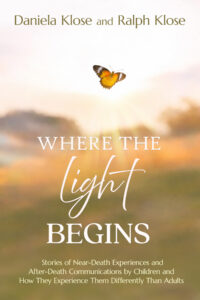 Ralph and Daniela Klose are German authors and long-term collaborative partners in the fields of neuroscience, psychology, and consciousness research. Their book Where the Light Begins explores near-death experiences in children.
Ralph is a retired neuropsychologist with over three decades of clinical and academic experience, and Daniela is a medical writer and translator specializing in neuropsychology and transpersonal psychology. For many years, they worked as ghostwriters for researchers across Europe. They now write under their own names, connecting scientific expertise with years of hospice and end-of-life care experience to explore near-death-experiences and liminal states of consciousness. https://drklose.com