Imagine sharing your life with someone from your very first breath. Someone who has stood beside you through birthdays and ordinary days, through familiar rituals and shared memories that seem to belong to the two of you alone. A person whose presence has always felt so natural that sometimes no words were needed at all.
Then, suddenly, they are gone.
For twins, such a loss may feel like more than saying goodbye to a sibling. It can mean losing someone whose life has been deeply intertwined with their own from the very beginning. But does the death of a twin truly bring that relationship to an end? Or can a bond so deeply woven continue in a different form?
Twins often hold a special place in each other’s lives. They usually grow up together, go through similar developmental stages at around the same time, and are often perceived by others as a unit. In particular, identical twins typically report a strong emotional closeness and a deeply interconnected sense of identity. Some experience themselves not simply as two siblings, but as parts of a shared whole.
The death of a twin is therefore not simply the loss of a loved one. It can also profoundly affect the surviving twin’s sense of self. Someone who has been a twin throughout their life remains a twin biologically and biographically but suddenly finds themselves alone in everyday life. Those who have experienced this loss sometimes describe this contradictory state with the words: “I am still a twin but I am no longer a twin.”
There is a particular aspect of this grief: the loss of a shared twin identity. This includes the feeling that the other twin had been a part of one’s own self. Therefore, some bereaved twins initially experience themselves as “half a person.” Others report that, when looking in the mirror, they are unsure for a moment whether they are seeing themselves or the deceased twin — a sense of uncertainty about which of the twins has actually died.
The intensity of grief depends primarily on the emotional and social closeness between the twins. On average, identical twins react more strongly and for a longer period to the loss than fraternal twins. However, genetic relatedness alone is not the determining factor. The amount of time spent together, mutual dependence, the roles within the relationship, and the circumstances of the death also influence the grieving process.
The loss can be particularly profound during childhood or adolescence. Children lose not only a sibling, but often also their closest playmate and the person whose presence had been taken for granted until then. Adolescents, in turn, are at a stage in which their personal and social identity is continuing to develop. The death of a twin can cause them to feel alienated or fundamentally different from their peers. Some withdraw, feel guilty about being the one who survived, or think that they have to go on living for both of them. Some also take on personality traits of their deceased twin and/or become overprotected by their parents.
However, grief does not necessarily mean giving up the relationship with the deceased entirely. Continuing bonds allow bereaved loved ones to maintain an inner relationship with someone who has died. This may be expressed through memories and thoughts, inner conversations, rituals, dreams, or the sense that the deceased twin continues to accompany them or that they can still perceive the twin’s presence. Many bereaved twins regard their deceased twin as a kind of guardian angel and wonder whether their twin is aware of important events in their lives. “I hear him when I’m not thinking,” says Matthew from our book Where the Light Begins about his twin brother Elijah, who passed away when he was nine years old.
Treasured belongings or keepsakes are also a sign of a continuing bond. After the death, for example, the surviving twin may initially leave the part of their shared room that belonged to the deceased twin unchanged. Over time, they begin to decide which belongings to keep and which can be given away. Eventually, the bereaved twin uses the entire room but keeps a shelf with their brother’s or sister’s treasured possessions. In this way, the memory is given a permanent place without completely determining the surviving twin’s own further development.
Continuing bonds can therefore support the process of moving forward in life and become a source of comfort, identity, and inner strength. Maybe the task of grief is not to end a relationship. Rather, it is about giving it a new form. The deceased twin remains part of one’s own life story, while the surviving twin gradually learns to live again as an individual. The bond does not simply disappear. Instead, it changes its shape, shifting from a relationship once lived side by side into a quiet presence that continues here and now.
Read true stories of children’s near-death experiences and how they responded to them in our book Where the Light Begins: Stories of Near-Death Experiences and After-Death Communications by Children and How They Experience Them Differently Than Adults.
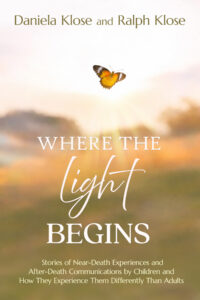 Ralph and Daniela Klose are German authors and long-term collaborative partners in the fields of neuroscience, psychology, and consciousness research. Their book Where the Light Begins explores near-death experiences in children.
Ralph is a retired neuropsychologist with over three decades of clinical and academic experience, and Daniela is a medical writer and translator specializing in neuropsychology and transpersonal psychology. For many years, they worked as ghostwriters for researchers across Europe. They now write under their own names, connecting scientific expertise with years of hospice and end-of-life care experience to explore near-death-experiences and liminal states of consciousness. https://drklose.com