
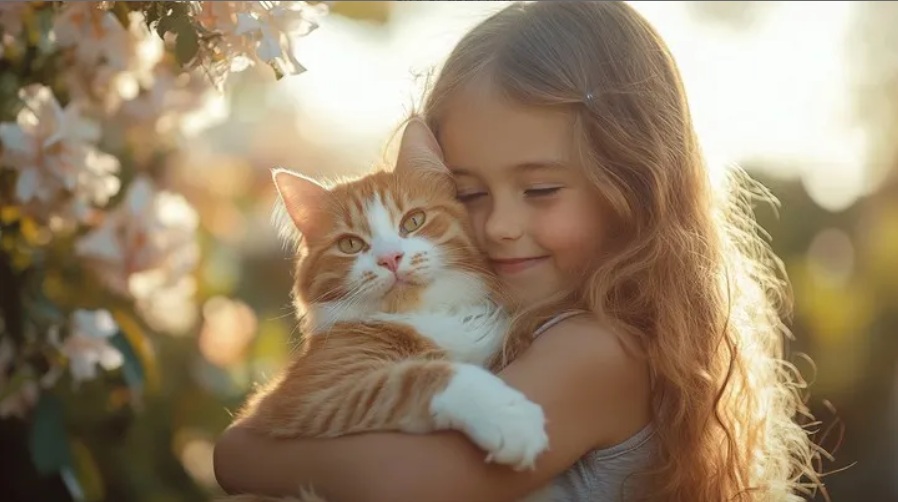
In extraordinary experiences at the threshold between life and death, such as near-death experiences, deathbed visions, or after-death communication, people encounter more than deceased relatives. Animals also appear time and again.
During near-death experiences, those affected particularly often encounter deceased pets (e.g. cats, dogs, or parakeets). This is especially noticeable among children. One possible explanation is that children are more likely to have known deceased pets than deceased relatives. Here, animals take on a role that, in other near-death accounts, is often played by deceased human relatives: they welcome, accompany, or send the experiencer back to their present life. However, other animals, such as a white lamb, can also become silent companions on the return journey and show the way back into one’s own body.
Deceased pets also hold a special place in possible after-death communication. Dogs, cats, horses, llamas, pigs, rabbits, or birds appear to be close once more to the people they have left behind. These encounters feel like a final farewell visit, accompanied by a quiet message: the familiar soul lives on and is well.
It becomes apparent that animals and their significance can vary widely across cultures. In the Indigenous cultures of North America, giant snakes, grizzly bears, or mountain lions often play a role in near-death experiences. Unlike familiar pets, they do not appear as companions but as dangerous trials between worlds. Thus, they embody danger, fear, and a test of courage. The path to the afterlife may open for a person precisely when they face the threatening animal without fear and continue on their journey undeterred.
In other Indigenous North American accounts, animals are encountered not only as beings who form a part of a peaceful afterlife landscape (for example deer, moose, and horses) but sometimes also as protective beings. For instance, a golden eagle is understood as a personal guardian spirit. Thus, animals function here as culturally shaped spiritual beings, as is also the case in the rainforests of South and Central America.
At the threshold between life and another reality stands the jaguar, who, during near-death experiences, is not simply a “guardian angel” but a powerful sentinel, teacher, and protector. Toma from the Amazon rainforest, featured in our book Where the Light Begins, noticed that in the jaguar’s gaze was “question, answer, love, and trial.”
In non-Western near-death experiences, animals are perceived not only as friendly and luminous, but also as having a strong moral significance. In Iranian near-death experiences, wolves are seen as embodiments of a person’s bad deeds, whereas beautiful birds in paradise-like landscapes embody good deeds.
The moral function of animals is particularly evident in Thai accounts, in which Yama, the Lord of the Dead, plays a judging role during the karmic review. Human mistreatment of animals is also punished here, so that in some near-death experiences, the mistreated animal, such as a rooster, appears as a silent witness to the deed. Mistreatment of animals prompts Yama to impose one or more rebirths in animal form on the human being responsible. By contrast, animals whom the person treated well during their lifetime help to ensure that they are allowed to return to their present life. The Buddhist — and also Hindu — tradition, which believes in the laws of karma, expresses it as follows: “Do good; receive good. Do bad; receive bad.”
Yama, the Lord of the Dead, also appears repeatedly in Indian near-death experiences. He usually rides a buffalo, which not only accompanies him but sometimes also serves as a mount for the experiencer’s return to their present life.
Interestingly in Japanese accounts, despite Buddhist traditions, deceased pets can act as familiar companions to the experiencer and show them the way back to life (for example, a former dog or horse), as is the case in Western accounts.
The concept of judgment and consequences for animal abusers can also be found in Central American near-death experiences. In these accounts, crocodiles can become guardians of a boundary — a crocodile-infested river — that not everyone is able to cross. This goes back to Maya mythology.
Animals in Deathbed Visions
Animals are also repeatedly encountered in end-of-life experiences and accompany dying people in their final perceptions. In Western studies, both deceased pets and forest animals are seen in deathbed visions. Those affected have the impression that the animals are waiting for them. Other animals seem to act as messengers of the approaching threshold and convey that “the time has come.” The latter, though, are not familiar pets but animal figures (e.g. a dog) that are interpreted as demonic beings in the context of traditional religious beliefs. Such appearances have been observed in South American cultures.
Palliative care professionals and relatives also occasionally report animals appearing at the time of death, shortly before it, or shortly afterward. Birds or insects are often observed in or near the patient’s room, and their appearance is interpreted as a quiet message or sign from the deceased. In the Philippines, black butterflies are repeatedly reported in connection with dying. In Filipino culture, they are regarded as omens of approaching death.
It becomes apparent that the role of animals in extraordinary experiences surrounding death and dying is closely intertwined with the respective cultural background. Animals are not at all merely figures on the margins of the experience. Rather, they appear as active participants and companions: they communicate, provide comfort, present challenges, and can even help determine whether a person returns to life or continues their journey into death.
Read true stories of children’s near-death experiences and how they responded to them in our book Where the Light Begins: Stories of Near-Death Experiences and After-Death Communications by Children and How They Experience Them Differently Than Adults.
 Ralph and Daniela Klose are German authors and long-term collaborative partners in the fields of neuroscience, psychology, and consciousness research. Their book Where the Light Begins explores near-death experiences in children.
Ralph is a retired neuropsychologist with over three decades of clinical and academic experience, and Daniela is a medical writer and translator specializing in neuropsychology and transpersonal psychology. For many years, they worked as ghostwriters for researchers across Europe. They now write under their own names, connecting scientific expertise with years of hospice and end-of-life care experience to explore near-death-experiences and liminal states of consciousness. https://drklose.com