

Encounters with deceased people are among the most striking features that are reported in connection with near-death experiences. Experiencers often encounter deceased relatives or other people close to them, who often welcome the experiencers to the afterlife or send them back to this life. Such experiences generally can be interpreted as expressions of memories, expectations, or a desire for comfort.
However, some reports contain an unusual detail: The person having a near-death experience encounters someone whose death they did not know about at the time.
The term “Peak in Darien” has become established for such cases. It derives from Frances Power Cobbe’s book The Peak in Darien, which was published in 1882 and deals with near-death phenomena. Cobbe, in turn, drew on a metaphor from a poem by the English poet John Keats. In it, Keats describes Spanish explorers who climb a peak in the region of present-day Panama. They expect to see a continent before them, but instead unexpectedly look out over an ocean unknown to them so far. The image conveys a moment of overwhelming surprise: Something appears that no one had expected.
A comparable element of surprise can be found in Peak in Darien experiences. A dying person perceives a relative whom they still believe to be alive. It only becomes known later that this relative had already died, possibly just a few hours or minutes earlier.
At the beginning of the twentieth century, the term “Peak in Darien” was first used in connection with deathbed visions in which dying people see individuals in their visions who, to their knowledge, are still alive. Sometimes, the experiencers themselves react with surprise during the encounter and wonder why the person in question is present. This element of surprise is particularly significant because it argues against the idea that the encounter only reflects the dying person’s conscious expectations of being reunited with deceased loved ones.
Later, as near-death research increasingly became established as a field of study, the term was applied to a specific type of near-death experience. Three types of Peak in Darien experiences can be distinguished.
In the first type, a person encounters someone they know who had died some time earlier, without the experiencer having learned of their death.
The second type involves encounters with people who died immediately before or around the time of the experience. In such cases, ordinary communication of the news of their death appears particularly unlikely.
In the third type of Peak in Darien cases, the experiencer sees a deceased person who is unknown to them but who has played an important role in their life — for example, the unknown biological father who is later recognized in a photograph.
However, unknown deceased individuals sometimes seem to “introduce themselves” nonverbally, as in the case of Eli from our book Where the Light Begins: “She knew me. And I knew right away she was my sister.”
Peak in Darien reports raise considerable challenges to simple psychological explanations. The expectation hypothesis may explain why a dying person sees a deceased relative whom they deeply miss. However, it is less convincing in explaining why someone encounters a person whose death was neither known nor expected.
Peak in Darien experiences force us to distinguish between what can be explained by expectations and memories and what seems to point beyond these explanations. Thus, such cases bring us to the limits of our current knowledge: to that unexpected peak from which a far greater horizon of consciousness may become visible than we have assumed so far.
Read fascinating cases of children’s near-death experiences in our book Where the Light Begins: Stories of Near-Death Experiences and After-Death Communications by Children and How They Experience Them Differently Than Adults.
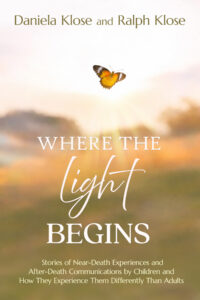 Ralph and Daniela Klose are German authors and long-term collaborative partners in the fields of neuroscience, psychology, and consciousness research. Their book Where the Light Begins explores near-death experiences in children.
Ralph is a retired neuropsychologist with over three decades of clinical and academic experience, and Daniela is a medical writer and translator specializing in neuropsychology and transpersonal psychology. For many years, they worked as ghostwriters for researchers across Europe. They now write under their own names, connecting scientific expertise with years of hospice and end-of-life care experience to explore near-death-experiences and liminal states of consciousness. https://drklose.com