
Around the world, reports of past-life memories are most often associated with children rather than adults. For decades, researchers studying reincarnation cases have noticed a striking pattern: children between the ages of three and seven are far more likely to speak spontaneously about another life than older children or adults.
A child may start talking spontaneously about the purported life of another person, including how they lived and the way in which they died. Sometimes, the past-life memories are triggered by certain environmental cues. Beyond verbal statements, the child may also have behaviors, preferences, talents, or skills that resemble those of the person from the past life. Some children are born with physical birthmarks or bodily defects that correspond to injuries sustained by that individual. The same applies to phobias and nightmares that appear to be related to the person’s death in the previous life.
The reason has fascinated psychologists and consciousness researchers. While no single explanation fully accounts for these findings, some observations are frequently noted: young children often describe memories that seem surprisingly specific, such as identifying the person from the previous life, the place where the person lived, and recognizing other objects and people from their past life. What is particularly interesting is that similar cases appear in cultures that do not share the same beliefs. Children from religious and non-religious families have all reported experiences that seem to follow comparable patterns.
As mentioned above, researchers have observed that most children stop talking about past-life memories by age six or seven, and the memories typically fade as they grow older. This consistent pattern raises an interesting question. Why do such experiences appear during a specific window and then gradually disappear?
One possible explanation is developmental. Usually, children start sharing their memories from a past life as soon as they can talk. The hippocampus, which plays a crucial role in the long-term storage of autobiographical memories, is not yet fully mature during the first years of life. Young children do not yet possess a fully developed autobiographical self and have not constructed the rigid personal narrative that adults rely on to organize reality. In other words, children may be more open to unusual experiences because they have not yet learned what is considered possible or impossible. The boundaries between imagination, memory, symbolic thinking, and direct experience are often more fluid.
Over time, school, friendships, daily routines, and the development of an adult identity begin to dominate. Earlier or unusual memories may become increasingly overshadowed or suppressed, making them more difficult to access with age. Thus, the early years retreat into the background. If ordinary early memories fade as the autobiographical self develops, it is conceivable, at least hypothetically, that the same process could apply to memories of previous lives.
Developmental psychology may help explain why such memories appear and disappear. However, it does not explain where the information originates. This has led some researchers to explore broader models of consciousness.
Research has also suggested that the answers might be found within the principles of quantum physics. Our physical world may be affected by or even rooted in a non-physical realm of consciousness. It is possible that consciousness may, in some form, continue to express itself in a new life. In this view, memories are never truly lost and may be carried over from one life to a subsequent one. Most people simply no longer have conscious access to them. In some children, however, these memories still surface before gradually fading as they grow older.
Although most reported past-life memories emerge during childhood, they can also occasionally appear during near-death experiences. They sometimes contain elements that experiencers interpret as connections to a former life. While in adults this connection usually appears during a life review, Jan from our book Where the Light Begins visited a house during his near-death experience and described it this way: “It wasn’t a place. It was a part of me that came back.”
For now, reincarnation remains a mystery. But maybe the persistence of reincarnation accounts across cultures and generations reminds us that life may be larger than a single biography and that some of our most intriguing sources continue to come from the voices of children.
Read true stories of children’s near-death experiences and how they responded to them in our book Where the Light Begins: Stories of Near-Death Experiences and After-Death Communications by Children and How They Experience Them Differently Than Adults.
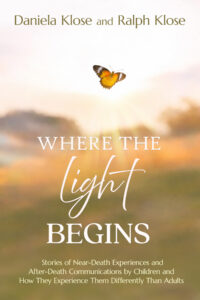 Ralph and Daniela Klose are German authors and long-term collaborative partners in the fields of neuroscience, psychology, and consciousness research. Their book Where the Light Begins explores near-death experiences in children.
Ralph is a retired neuropsychologist with over three decades of clinical and academic experience, and Daniela is a medical writer and translator specializing in neuropsychology and transpersonal psychology. For many years, they worked as ghostwriters for researchers across Europe. They now write under their own names, connecting scientific expertise with years of hospice and end-of-life care experience to explore near-death-experiences and liminal states of consciousness. https://drklose.com