
We love the idea that we’re in control of our lives. That we’re the authors of our story. That our perspective shapes our reality. It sounds empowering. It is empowering… to a point. But there’s a problem baked into it that almost no one talks about.
You’re defining your entire life experience using a mind that was conditioned before you even knew what you were doing. That should bother you.
Because it means most of what you call “your perspective” isn’t actually yours. It’s inherited, absorbed, and unconsciously reinforced over years. And now that same limited lens is being used to interpret everything that happens to you.
You’re not just creating meaning. You’re recycling it.
You Don’t Experience Life Directly
You experience your interpretation of it. Something happens. A text goes unanswered. A job opportunity falls through. Someone pulls away. You feel a shift in energy.
Immediately, your mind goes to work.
“They’re losing interest.”
“I’m not good enough.”
“This always happens to me.”
“People can’t be trusted.”
None of those are facts. They’re conclusions. And here’s the kicker. You don’t even realize you’re making them. It feels like you’re seeing reality clearly, but you’re not. You’re filtering it through a narrow, pre-built framework made up of past experiences, emotional wounds, societal conditioning, and whatever beliefs you picked up along the way.
Your brain isn’t designed to show you truth. It’s designed to keep you consistent. So once you’ve decided what something means, your mind will look for evidence to support it. It will ignore anything that contradicts it. And just like that, your interpretation hardens into “reality.”
Meaning-Making Is Automatic… and Dangerous
Humans are meaning-making machines. We can’t help it. The mind hates uncertainty, so it fills in the gaps. It connects dots that aren’t necessarily connected. It creates stories to make sense of things that don’t actually require a story. That’s fine when the meaning is neutral or helpful. But most of the time, it’s not.
Most of the time, the meaning you assign is rooted in fear, insecurity, or outdated beliefs about yourself.
You don’t just say, “That person hasn’t responded.”
You say, “They’re ignoring me.”
You don’t just say, “This didn’t work out.”
You say, “Nothing ever works out for me.”
You take a single moment and stretch it into a narrative about your entire life. And then you live inside that narrative like it’s the truth.
Your Awareness Is Limited… But You Act Like It’s Absolute
Here’s where it really falls apart.
You’re assigning meaning to events while having a fraction of the information.
You don’t know what someone else is thinking.
You don’t know what’s happening behind the scenes.
You don’t know how something will unfold in the future.
You don’t know what this moment is leading to.
And yet, you decide what it means anyway. That’s wild when you really think about it. You’re making definitive statements about your life based on incomplete data, filtered through a biased lens, influenced by past experiences that may not even be relevant anymore. It’s like trying to understand a movie by watching one random scene and assuming you know the entire plot. And then reacting emotionally as if your interpretation is the only possible one.
The Real Problem Isn’t That You Define Meaning
The problem is that you trust it. You believe your first interpretation is accurate. You assume your emotional reaction is justified. You double down on stories that were formed in moments of pain, rejection, or confusion, and then carry them forward like they’re reliable. That’s how people stay stuck. Not because life is inherently limiting, but because their interpretation of life is.
You’re Living in a Self-Created Loop
Once you assign meaning, it doesn’t just sit there. It shapes how you show up.
If you believe people lose interest in you, you’ll start acting guarded.
If you believe nothing works out, you’ll hesitate to try.
If you believe you’re not enough, you’ll settle for less.
And then, predictably, your actions create outcomes that seem to confirm your beliefs. So now you’re not just interpreting reality. You’re reinforcing it. It becomes a loop.
Belief → Interpretation → Behavior → Outcome → Reinforced Belief
And the whole thing started with a meaning you made up.
So What’s the Alternative?
You don’t stop assigning meaning. That’s not realistic. But you start questioning it. You catch yourself in the moment where your mind jumps to a conclusion and you pause.
“Is that actually true?”
“What else could this mean?”
“What am I assuming here?”
You loosen your grip on your interpretations. You stop treating your thoughts like facts. You create space between what happens and what you decide it means. That space changes everything. Because in that space, you’re no longer trapped inside your conditioning. You’re aware of it. And awareness is where real freedom starts.
You’re Not as Limited as You Think… But Your Thinking Is
Life isn’t as rigid as your interpretations make it. There are more possibilities, more perspectives, more outcomes than your current awareness allows you to see. But you won’t access any of that if you keep defaulting to the same meanings. You don’t expand your life by controlling everything that happens. You expand your life by loosening the grip on what you think it means.
Final Thought
You defining your life experience isn’t the problem. You doing it unconsciously is. Because when you’re not aware of how you’re shaping your reality, you’re not actually in control of it. You’re just repeating it. And there’s a very different life available to you the moment you start questioning the stories you’ve been telling yourself.
If this hit something in you, my book Radical Remembering goes much deeper into this. It breaks down how we’ve been conditioned to see ourselves, God, and life itself through inherited lenses and how to dismantle those narratives so you can actually experience something real.
Not the recycled version.
The truth.
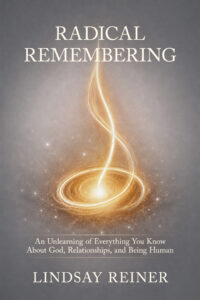 Lindsay Reiner is a writer and visionary exploring what remains when inherited beliefs about God, love, and identity fall away. Her work examines how internal narratives shape human experience and how unlearning can become a path back to truth, agency, and wholeness. Drawing from lived experience, deep inquiry, and spiritual reflection outside religious doctrine, she invites readers to question what they were taught to fear, suppress, or outsource. Radical Remembering is her debut book. https://lindsayreiner.com