
When people hear about childhood near-death experiences, they often focus on the positive changes that follow. Many children return with less fear of death, a greater sense of inner peace, and a deep feeling of connection to other people and to life itself.
However, for some children, the return from a near-death experience can be difficult. They may struggle to reconnect with the pace and intensity of everyday life as everything feels different from the life they lived before. The nervous system seems to re-enter ordinary life from an altered state of reality without having restored its usual filters, and therefore, it responds differently to external stimuli. As a result, children like Elin from our book Where the Light Begins have increased sensitivity to bright light, loud noises, and being touched. Elin withdrew, hid under blankets, and avoided hugs.
The reordering of the nervous system can also lead to synesthesia, a merging of sensory impressions. Although synesthesia can occur independently of near-death experiences, it has been reported by some children, as was the case with Mira, another child from our book, who felt sounds as colors and sensed fabrics as tones. In some cases, there is also an increased sensitivity to medications or electromagnetic items. The latter can result in effects such as watches failing to work properly.
In addition to changes in sensory perception, many children also describe profound shifts in how they relate and communicate with others. Speaking is difficult for these children, leading them to whisper or remain silent for some time; yet they listen and, if they speak, they do so with enhanced empathy and mindfulness.
The latter is the result of increased compassion. Some children become highly aware of other people’s feelings. They notice sadness before it is spoken. Conflict or cruelty affects them deeply. Increased compassion can be both a gift and a challenge. The same openness that allows a child to feel deeply connected to others can also make everyday life more difficult to manage. One of the greatest challenges is that many children do not fully understand what is happening to them. They simply know that the world feels different from what it did before. Things that once seemed ordinary suddenly feel overwhelming. At the same time, they often lack the language to explain these changes. As a result, many feel misunderstood or alone with their experiences, leading some childhood near-death experiencers to undergo psychotherapy to reconcile their extraordinary experiences.
Over time, many children gradually learn to integrate these changes. Some discover ways of self-expression through art, music, or writing. Others find comfort in nature. They learn how to live with a heightened sensitivity that once felt overwhelming.
The stories explored throughout our book, Where the Light Begins, remind us that the journey back into life does not end when a child survives. In many ways, another journey begins: the gradual task of integrating an extraordinary experience into ordinary life.
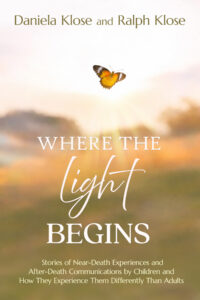 Ralph and Daniela Klose are German authors and long-term collaborative partners in the fields of neuroscience, psychology, and consciousness research. Their book Where the Light Begins explores near-death experiences in children.
Ralph is a retired neuropsychologist with over three decades of clinical and academic experience, and Daniela is a medical writer and translator specializing in neuropsychology and transpersonal psychology. For many years, they worked as ghostwriters for researchers across Europe. They now write under their own names, connecting scientific expertise with years of hospice and end-of-life care experience to explore near-death-experiences and liminal states of consciousness. https://drklose.com