
Are you getting God wrong? That question makes people uncomfortable. Good. It should.
Because the moment you question religion, people assume you’re attacking God. Or morality. Or meaning itself. You’re not. You’re questioning the systems that were built around something sacred and turned it into something rigid, controlled, and, at times, destructive. Let’s stop dancing around it.
Religion has shaped entire civilizations. It has also divided them. It has given people purpose, community, and structure. It has also justified war, violence, and the idea that one group of people is more “right” than another. Both things are true. And pretending otherwise is part of the problem.
Let’s start with what religion does on a personal level.
It tells people what to believe instead of teaching them how to think. It hands out answers before people even know the questions they’re meant to ask. It creates a framework where doubt feels dangerous, curiosity feels rebellious, and personal truth gets overridden by doctrine. And once that framework is in place, it’s hard to see beyond it.
Most people inherit their religion the same way they inherit their last name. It’s not chosen. It’s absorbed. Repeated. Reinforced. By family, by community, by culture. Before you’re even old enough to think critically, you’re already being told what God is, what truth is, what’s right, what’s wrong, who belongs, and who doesn’t. That’s not faith. That’s conditioning. And conditioning doesn’t just shape individuals. It shapes groups.
Once a belief system becomes tied to identity, it stops being just a personal framework. It becomes something people defend. Protect. Fight for. This is where things start to get dangerous.
Because the moment a group believes it holds the absolute truth, everyone outside of that group becomes wrong by default. And when “wrong” gets tied to morality, righteousness, or even salvation, it creates a quiet hierarchy of human value.
Some are in. Some are out.
Some are saved. Some are lost.
Some are right. Some are dangerous.
That mindset doesn’t stay contained in churches, mosques, or temples. It spills into politics, culture, and history. Wars have been fought in the name of religion for centuries. Not just as a background factor, but as a driving force. People have gone to battle believing they were on the side of God, that their cause was Divinely justified, that opposing forces weren’t just different, but fundamentally wrong or even evil.
And once you believe God is on your side, almost anything can be rationalized.
Violence becomes righteous.
Domination becomes necessary.
Dehumanization becomes easier.
To be clear, religion isn’t the only cause of war. Power, land, money, and control have always been part of the equation. But religion has a unique ability to intensify conflict because it doesn’t just argue over territory. It argues over truth, identity, and eternal meaning. You’re not just fighting over land. You’re fighting over who is right about God. That’s a different level of intensity.
And even outside of large-scale war, the same dynamic shows up in smaller ways. Families divided over belief systems. Communities that exclude or judge those who don’t conform. People who carry quiet shame because they don’t fully align with what they’ve been taught. All of it stems from the same root. Certainty without room for questioning.
If God is infinite, how could any single institution fully define it?
If truth is universal, why are there thousands of religions, all claiming to be the right one?
If love is at the core of the Divine, why does religion so often divide, judge, exclude, and, at times, destroy?
These aren’t abstract questions. They cut straight to the foundation of what people have been taught to believe. And most people don’t ask them out loud. Because the cost of asking can feel high. You risk losing your sense of belonging. You risk disappointing people you love. You risk stepping into the unknown without a map. So people stay. Even when something feels off.
They stay in belief systems that don’t fully resonate. They repeat prayers that don’t feel alive. They follow rules they don’t understand. And over time, they disconnect from their own inner voice, because they’ve been taught to trust something external more than themselves.
That’s the real problem. Religion, at its worst, replaces direct connection with secondhand interpretation. It puts a middleman between you and the Divine. It teaches you to look outward for validation instead of inward for truth. You don’t need a translator for something that already lives within you.
And yet, that’s exactly what many religious structures depend on. Authority. Hierarchy. Control over interpretation. Because if people start realizing they can access God, truth, or meaning without an institution, the structure starts to weaken.
That doesn’t mean religion is entirely bad. It has offered community, structure, and comfort to millions of people. It has created rituals that bring people together and language that helps people make sense of the unknown. But comfort and truth are not the same thing.
A system can feel safe and still be limiting.
A belief can feel familiar and still be incomplete.
A tradition can feel meaningful and still be rooted in ideas that no longer serve you.
The problem is that religion often discourages that level of discernment. It rewards obedience over exploration. Certainty over questioning. Belonging over authenticity. And that comes at a cost.
Because when people are taught to suppress their doubts, they also suppress their intuition. When they’re taught that truth exists outside of them, they stop learning how to access it within themselves. When they’re told that God is something distant, something to be feared or earned, they lose sight of the possibility that the Divine might be closer than they’ve ever been told. Right here. Within them. Accessible without permission.
That idea is threatening to organized systems, but it’s freeing to individuals. And that’s where the shift begins. Not by rejecting God. Not by abandoning spirituality. But by questioning the structures that claim ownership over both.
It looks like asking uncomfortable questions and not rushing to fill the silence with someone else’s answers. It looks like being willing to sit in uncertainty instead of clinging to inherited beliefs. It looks like choosing alignment over approval, even when that choice isolates you for a while. Because it probably will.
When you step outside of a shared belief system, you lose the built-in community that comes with it. You lose the script. The certainty. The feeling of being “right” in a group of people who all agree with you. What you gain is something far more valuable.
Yourself. Your own perspective. Your own connection. Your own understanding of what truth feels like, not what it’s supposed to sound like. And from that place, something more honest can emerge.
A relationship with the Divine that isn’t filtered through fear, guilt, or obligation. A sense of morality that comes from awareness and empathy, not just rules. A way of moving through the world that’s rooted in curiosity instead of certainty.
That kind of spirituality doesn’t need a label. It doesn’t need a box. It doesn’t need to be defended. It just is. And here’s the part no one says out loud. A lot of people already feel this.
They sense the gaps. The contradictions. The parts that don’t quite add up. But they push those feelings down because questioning religion can feel like questioning everything. Your identity. Your family. Your place in the world.
So they stay quiet.
They nod along.
They keep the peace.
But silence doesn’t make something true. It just keeps it unexamined.
Religion isn’t the problem because it exists. It becomes a problem when it replaces personal truth with imposed belief. When it discourages growth instead of supporting it. When it fuels division instead of connection. When it’s used to justify harm instead of deepen love.
And maybe the reason no one is talking about it isn’t because it’s not happening. It’s because deep down, people know exactly what they’d find if they started asking the right questions. And they’re not sure they’re ready to live with the answers.
If this stirred something in you, that’s the point.
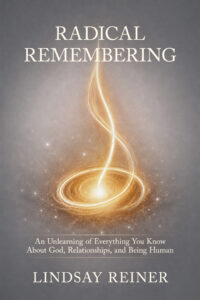
My book Radical Remembering is an invitation to question everything you’ve been taught about God, yourself, and the way life works. Not to leave you lost, but to bring you back to something deeper and more honest. It’s about stripping away inherited beliefs, reconnecting with your own inner knowing, and building a relationship with the Divine that doesn’t rely on a middleman.
This isn’t about becoming someone new. It’s about remembering who you were before the world told you who to be.
 Lindsay Reiner is a writer and visionary exploring what remains when inherited beliefs about God, love, and identity fall away. Her work examines how internal narratives shape human experience and how unlearning can become a path back to truth, agency, and wholeness. Drawing from lived experience, deep inquiry, and spiritual reflection outside religious doctrine, she invites readers to question what they were taught to fear, suppress, or outsource. Radical Remembering is her debut book. https://lindsayreiner.com