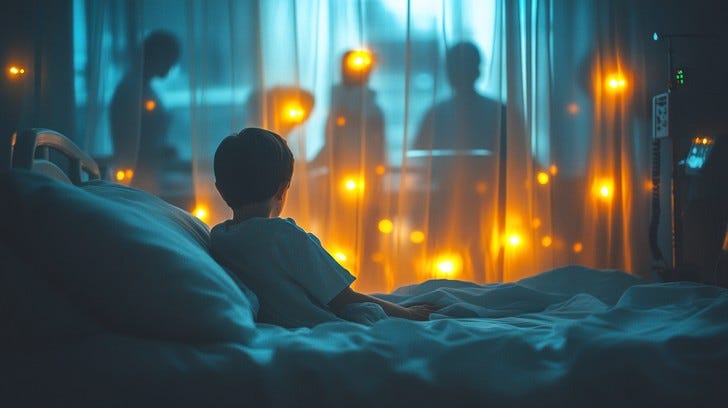
Especially at the threshold of life, people repeatedly report experiences that raise profound questions. Among these are the so-called deathbed visions, which occur during the final days or hours before death. Children, who often have not yet developed firmly established religious beliefs or a fixed worldview, frequently describe these end-of-life visions with remarkable openness and naturalness, without interpreting their experiences through preconceived conceptual frameworks.
Many children report encounters with deceased relatives (particularly grandparents), deceased pets, as well as other children who had died in the same hospital or hospice. Some also describe angels or beings of light, a bright light, or a peaceful place beyond that light. During the deathbed visions, children often respond purposefully to individuals and direct their gaze toward specific spots in the room, as though they were perceiving someone there. Particularly thought-provoking are the few reported cases in which children describe deceased individuals whom they had never met during their lifetime or, in some instances, had not even known they existed. Nevertheless, the children describe them with remarkable accuracy.
Besides the content of these visions, another aspect has been observed: the extraordinary state of consciousness many children show during these experiences. Some had previously been barely responsive or had been in a coma. Yet during these episodes, they appear fully conscious, awake, oriented, and are able to engage in clear, coherent conversations. This condition is known as terminal lucidity, a state in which individuals nearing death temporarily regain an unusual degree of mental clarity and the ability to communicate, often after these capacities had been diminished or lost during the course of their illness or the dying process.
Furthermore, many children report a profound inner knowing that their lives are coming to an end. Dalia, from our book Where the Light Begins, expresses it this way: “There’s someone there. … And she’s waiting.” Such statements reflect a remarkable sense of inner clarity in the final moments before death. Children often speak of the feeling that they are “going home.”
In addition to these waking experiences, some children’s end-of-life experiences may also occur during vivid dreams and, in some cases, appear to be precognitive. For example, a child may see the exact funeral home where their body will later be taken after death, despite having no prior knowledge of the funeral home’s appearance, name, or location.
Reports of deathbed visions inevitably raise the question of how these experiences can be understood from a scientific perspective. Some consciousness researchers interpret those visions as a possible expression of a transitional process in which consciousness enters another state that is independent of the brain. According to this view, consciousness returns to a broader nonlocal field from which it originally emerged. During a person’s lifetime, consciousness is understood to be expressed through the brain rather than generated by it. Thus, the brain may function more like a receiver or tuning device.
Deathbed visions constitute a natural part of the dying process, offering comfort, reassurance, and peace to the children experiencing them and, in some cases, also helping their relatives through the process of saying goodbye. For many families, these experiences become precious memories that imbue the farewell with hope, love, and a sense of inner peace.
Read true stories of children’s near-death experiences and how they responded to them in our book Where the Light Begins: Stories of Near-Death Experiences and After-Death Communications by Children and How They Experience Them Differently Than Adults.
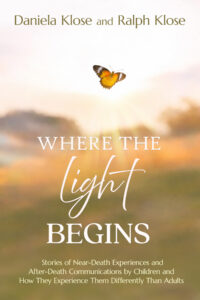 Ralph and Daniela Klose are German authors and long-term collaborative partners in the fields of neuroscience, psychology, and consciousness research. Their book Where the Light Begins explores near-death experiences in children.
Ralph is a retired neuropsychologist with over three decades of clinical and academic experience, and Daniela is a medical writer and translator specializing in neuropsychology and transpersonal psychology. For many years, they worked as ghostwriters for researchers across Europe. They now write under their own names, connecting scientific expertise with years of hospice and end-of-life care experience to explore near-death-experiences and liminal states of consciousness. https://drklose.com