
The death of a loved one often changes a person’s life in profound ways. In such situations, adults frequently wonder how children process grief, what thoughts occupy their minds, and how they cope with the loss. However, less well known is that some children report extraordinary experiences following the death of someone close to them. In the scientific literature, these experiences are referred to as after-death communication.
These are occurrences in which bereaved individuals have the impression that they are in contact with a deceased person or perceive the person’s presence. Bereaved children often report that they can still hear the deceased. Some describe the impression that the deceased speaks to them, while others even report brief conversations. These experiences occur particularly often during the first months following a loss and appear to be more common among younger children. In addition to hearing the deceased, many children report a strong sense of the person’s presence. They feel that the deceased is still with them and continues to accompany them.
In bereavement research, these aspects are often understood as continuing bonds, referring to an ongoing inner connection with the deceased. For children in particular, the idea of maintaining a continuing relationship with the person who has died often plays an important role. This relationship does not have to be consciously sought. Rather, many children, such as Lilia from our book Where the Light Begins, report that the sudden feeling of the deceased’s presence arises entirely spontaneously.
Continuing bonds are often especially evident between siblings. Siblings frequently describe dreams in which their deceased brother or sister appears, speaks with them, and tells them that he or she is in a safe place. In addition to hearing the deceased’s voice, perceiving a familiar scent, or feeling a touch, some report the impression that their deceased sibling is protecting them or is especially close during certain moments. Others describe receiving signs or warnings. One example of such a sign is a clock suddenly stopping, as experienced by Matthew in our book Where the Light Begins.
Studies show that after-death communication is far more common than many people assume. This has contributed to a much more nuanced scientific understanding of these phenomena than was the case a few decades ago. Whereas unusual perceptions were once often hastily classified as hallucinations or as signs of psychological distress, research now indicates that so-called sensory and quasi-sensory experiences of the deceased are a prevalent feature of bereavement, including among adults. Depending on the study, between 47 and 82 percent of bereaved people report having had at least one such experience.
For many children, after-death communication provides comfort, hope, reassurance, and a sense of continuing connection with the person who has died. It reminds us that grief is a deeply human process in which people, and especially children, sometimes encounter phenomena that defy simple explanations. For many families, these experiences become some of the most intense aspects of the grieving process.
The stories shared in our book Where the Light Begins: Stories of Near-Death Experiences and After-Death Communications by Children and How They Experience Them Differently Than Adults also remind us that the enduring bonds of love between family members transcend loss and speak to the very essence of being human.
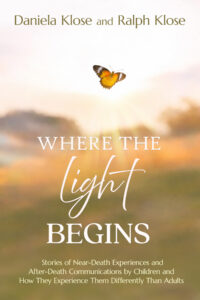 Ralph and Daniela Klose are German authors and long-term collaborative partners in the fields of neuroscience, psychology, and consciousness research. Their book Where the Light Begins explores near-death experiences in children.
Ralph is a retired neuropsychologist with over three decades of clinical and academic experience, and Daniela is a medical writer and translator specializing in neuropsychology and transpersonal psychology. For many years, they worked as ghostwriters for researchers across Europe. They now write under their own names, connecting scientific expertise with years of hospice and end-of-life care experience to explore near-death-experiences and liminal states of consciousness. https://drklose.com