Every year at the end of October, Halloween celebrations take place in the U.S. and around the world. Spooky figures are hung along streets and outside homes. Children, as well as adults, dress up in costumes, go from door to door, and call out “Trick or treat!”
In Ireland, Halloween is also known as Samhain. During this ancient Celtic festival, it was believed that the boundary between the physical world and the otherworld grew thinner on Samhain night, making it easier for ancestors, spirits, and fairies to cross over from one world to the other.
In the ancient Celtic calendar, Samhain marked the beginning of winter on November 1. The night before, October 31, is called Oíche Shamhna in Irish. Thus, Samhain marked not only a change of seasons but also a threshold: the light faded, nature withdrew, and the dark half of the year began.
The deceased and ancestors were respectfully honored, for example, by setting a place at the table or creating an ancestral altar. Quietly, contemplatively, and with gratitude. With candles, incense, and memories rather than costumes, jack-o’-lanterns, and parties. It was – and still is –a remembrance of the dead.
A remembrance of the dead that is often given far too little space in our hectic everyday lives. We remember the deceased person on the anniversary of their death, on their birthday, perhaps at Christmas or on another religious holiday. For the rest of the year, we try to avoid thinking about them, so that we do not become aware of our own mortality.
The awareness of our mortality should encourage us to live with humility and not deal too long with unimportant things. But this is becoming more and more difficult in today’s fast-paced world. Have you already checked social media today? Is the new phone coming out soon? Finding time to connect with nature and our own bodies, for example by taking a walk in the woods, takes a conscious effort.
Perhaps this is where a deeper meaning of Halloween lies. For one night, the festival brings back visible images of death into everyday life. Although we encounter skeletons, ghosts, and gravestones in playful or exaggerated forms, behind them lies a reality that affects us all. Death is dressed up, illuminated, and sometimes even laughed at. In this way, it loses some of its horror for a moment.
Children often approach these images more openly than adults. They dress up as ghosts, vampires, or other beings, moving with ease between fantasy and reality. At the same time, they ask very direct questions: Where are people who have died now? Can they still see us? Will they ever come back? Adults often feel unsure how to respond to such questions, even though children usually do not expect ready-made explanations. Often, what they want most is an honest answer and the feeling that they are not alone with their thoughts.
Younger children often initially understand death as a form of leaving or sleeping from which a person might return. Only gradually do they develop an understanding that death is final and that everyone is mortal. Therefore, Halloween can also offer a gentle opportunity to talk with them about loss and remembrance, without overwhelming them with explanations.
For adults, too, confronting our own mortality can hold something valuable. It does not have to lead to fear or melancholy. Instead, knowing that our time is limited can help us recognize which relationships, experiences, and moments truly matter to us. Some conflicts become less important. A conversation, a touch, or a walk suddenly no longer seem like things we take for granted.
Our relationship with someone who has died does not necessarily end with their death. It can continue through memories, inner conversations, dreams, and familiar rituals. A particular song, a scent, or a familiar place can make the person feel present again for a moment. Such continuing bonds do not mean that the loss is being denied. They can help us to give the deceased a new place in our lives.
Maybe this is why we need more quiet ways of remembering again. At Halloween, alongside all the costumes and candies, we could light a candle for someone who is no longer with us. We could say their name, share a story about a time we spent together, or look at a photograph.
Therefore, Halloween does not have to be solely a spooky spectacle or a somber reflection on death. It can bring both together: joy and remembrance, merriment and tranquility.
When the pumpkins glow in the night and children go from house to house, we could also pause for a moment. Not out of fear of death, but out of gratitude for life. And for all those who are no longer visibly by our side but remain part of our story.
Children’s relationship with death is also evident in our book Where the Light Begins: Stories of Near-Death Experiences and After-Death Communications by Children and How They Experience Them Differently Than Adults.
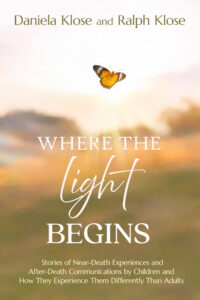 Ralph and Daniela Klose are German authors and long-term collaborative partners in the fields of neuroscience, psychology, and consciousness research. Their book Where the Light Begins explores near-death experiences in children.
Ralph is a retired neuropsychologist with over three decades of clinical and academic experience, and Daniela is a medical writer and translator specializing in neuropsychology and transpersonal psychology. For many years, they worked as ghostwriters for researchers across Europe. They now write under their own names, connecting scientific expertise with years of hospice and end-of-life care experience to explore near-death-experiences and liminal states of consciousness. https://drklose.com