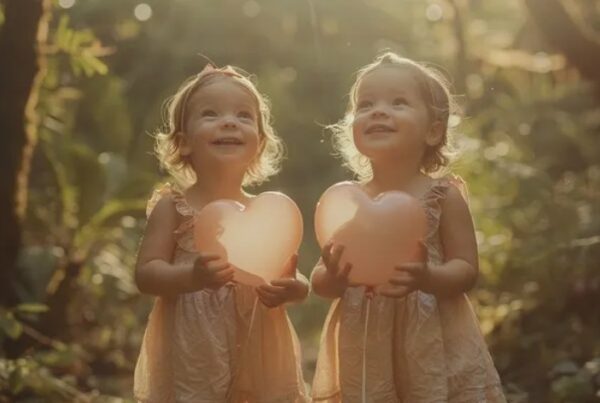

Children who experience a near-death experience often return profoundly changed. Even children who are too young to have learned expectations about death know that they have made a transition to some realm beyond life.
Their experiences teach us something about death that many adults lose over the course of their lives: an immediate, unfiltered relationship to the threshold between life and death is possible.
Children remind us that a fear of death is often more culturally learned than originally felt and that language itself is often insufficient to fully describe their experiences. After a near-death experience, children do not speak in religious doctrines, but in images: light, music, a garden of voices.
Many of them return with a stronger sense of calmness, trust, and acceptance, as well as the knowledge of continuity beyond life. Several studies describe children who experience overwhelming feelings of peace, love, joy, stillness, or a profound sense of coming home.
Children’s near-death experiences are often simpler than those reported by adults and frequently include transcendental elements such as peaceful darkness, altered perceptions of time, and an intuitive sense of knowing.
The deeply comforting and transformative nature of a near-death experience also leads to an acceptance or normalization of death. As well as an increased sense of meaning in life and lasting positive personality changes, such as stronger spiritual awareness and greater compassion for others.
Some children express a deep certainty that consciousness continues beyond physical death. Amina from our book Where the Light Begins developed a deep trust in life and in the connection between all things; that everybody is connected to something greater. Another girl, Catherine, began to exhibit an unusual depth and could feel what others could not say. She noticed pain, especially in animals, small children, and the elderly. She was also grateful for little things, such as the golden hue of morning light or the scent of lavender on a blanket. Such accounts suggest that near-death experiences may fundamentally change how some children perceive mortality and existence itself.
While many children lose their fear of death, reintegration into everyday reality can be especially difficult for children. Some struggle intensely with the psychological aftermath of returning, as the everyday reality of harsh light, loud words, and fast movements is often in contrast to a realm of overwhelming love or peace.
Although adults often try to suppress the awareness of mortality, there is a quiet naturalness with which many children think about death afterward. Some parents later reported that their children no longer asked, “Will I have to die?” but rather, “Why are adults so afraid of it?”
Maybe this is where one of the deepest transformations lies. Many children no longer seem to perceive death solely as an ending, but as a transition; something that belongs to life without diminishing its value.
This does not mean that these children no longer suffer or feel grief. Many continue to struggle with illness, isolation, or the feeling of not being understood by others. And yet, at the same time, countless families describe a new kind of inner peace, compassion, or emotional maturity that had not existed before the near-death experience.
This is not about romanticizing death or denying suffering. Illness, loss, and farewell remain painful. But children remind us of something often lost in adulthood: not everything needs to be controlled, explained, or fully understood to hold meaning.
Maybe this is one of the quietest messages carried by many childhood near-death experiences: that life and death may not be as separate as adults often perceive them to be. And one of the most important lessons these children offer is that fear does not always disappear when we find certainty, but sometimes when we begin to meet the unknown with openness, compassion, and wonder.
Read true stories of children’s near-death experiences and how they responded to them in our book Where the Light Begins: Stories of Near-Death Experiences and After-Death Communications by Children and How They Experience Them Differently Than Adults.
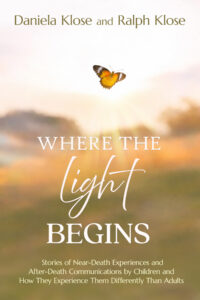
Ralph and Daniela Klose are German authors and long-term collaborative partners in the fields of neuroscience, psychology, and consciousness research. Their book Where the Light Begins explores near-death experiences in children.
Ralph is a retired neuropsychologist with over three decades of clinical and academic experience, and Daniela is a medical writer and translator specializing in neuropsychology and transpersonal psychology. For many years, they worked as ghostwriters for researchers across Europe. They now write under their own names, connecting scientific expertise with years of hospice and end-of-life care experience to explore near-death-experiences and liminal states of consciousness. https://drklose.com