
Most people hear “your thoughts shape your reality” and immediately roll their eyes. It sounds like something pulled from a vision board workshop or a late-night motivational video. And honestly, the way it’s usually framed doesn’t help. You’re not going to think your way into a Lamborghini. That’s not how this works.
But your thoughts are designing your life. Not in some magical, instant manifestation sense. In a much quieter, more practical, and honestly more powerful way. Your thoughts shape what you notice, how you interpret it, and what you do next. That combination builds your life, one decision at a time.
Start with something simple. Two people can go through the exact same experience and walk away with completely different conclusions. One sees rejection and thinks, “I’m not good enough.” The other sees the same situation and thinks, “That wasn’t a fit.” Same event. Completely different internal narrative. Completely different emotional response. Completely different next move.
That’s where your life starts to split.
Your brain is constantly filtering reality. There’s too much information coming in at all times, so it has to decide what matters. And it uses your existing beliefs to do that. If you believe people are unreliable, you’ll notice every time someone flakes and overlook the times they show up. If you believe you’re hard to love, you’ll scan for signs that confirm it and ignore anything that contradicts it.
You’re not seeing reality as it is. You’re seeing reality as it matches your story.
And here’s the part most people don’t want to admit. Once you see something through that lens, you start acting in ways that reinforce it.
If you believe you’re not that important to someone, you might hold back. You won’t express what you want. You’ll accept less. You’ll tolerate inconsistency. You’ll overanalyze their behavior instead of asking directly. Then, when they don’t step up, it feels like proof. “See? I knew it.”
But your behavior helped create that outcome.
This isn’t about blame. It’s about awareness. Because once you see the pattern, you realize how much control you actually have.
Your thoughts aren’t just passive commentary. They’re instructions.
They tell you what to expect. They tell you what’s normal. They tell you what’s acceptable. And over time, they define your standards.
Think about what you tolerate in your relationships, your work, your daily life. That tolerance isn’t random. It’s tied directly to what you believe you deserve and what you think is possible.
If your inner narrative says, “This is just how people are,” you’ll stay in situations that drain you. If it says, “This is the best I can do,” you’ll stop reaching for better. If it says, “I always mess things up,” you’ll hesitate, overthink, or avoid trying at all.
Those thoughts don’t just sit in your head. They shape your choices. And your choices shape your life.
At the same time, your thoughts influence what you even see as an option.
Opportunities don’t always announce themselves. They often show up as subtle openings. A conversation. An idea. A moment where you could speak up or take a risk. If your default thinking leans toward doubt or fear, you’ll miss those openings or talk yourself out of them.
It’s not that the opportunity wasn’t there. It’s that your mind filtered it out.
On the flip side, when your thinking shifts, your world starts to look different. Not because reality magically changed, but because your perception did.
You start noticing things you would have ignored before. You interpret situations with more flexibility. You respond instead of react. You raise your standards. You make cleaner decisions.
And over time, those small shifts stack up.
This is why changing your life rarely comes from one big breakthrough. It comes from changing the way you think in ordinary moments.
It’s how you interpret a delayed text.
It’s what you tell yourself after a mistake.
It’s the story you attach to someone else’s behavior.
It’s the meaning you assign to discomfort.
Those moments feel small, but they’re where your patterns live.
If you always assume the worst, you’ll feel anxious more often. If you take things personally by default, your relationships will feel heavier than they need to. If you constantly question your own worth, you’ll second-guess decisions that could actually move you forward.
None of that requires a major life event. It happens quietly, daily.
So what do you do with that?
You don’t try to force positive thinking. That usually backfires. Telling yourself everything is amazing when it’s clearly not just creates more internal tension.
Instead, you get curious about your thoughts.
You start noticing the patterns without immediately believing them.
When something triggers you, pause and ask, “What am I making this mean?” Not what happened. What you decided it means. That’s where your narrative lives.
Then ask, “Is that the only possible interpretation?” Most of the time, it’s not. There are always multiple ways to read a situation, but your brain defaults to the one it knows best.
You’re not trying to lie to yourself. You’re widening the lens.
Over time, this creates space between you and your automatic reactions. And in that space, you get to choose differently.
You might still feel the same initial emotion, but you don’t have to follow it blindly. You can respond with more intention. You can set a boundary instead of staying silent. You can take a risk instead of assuming failure. You can let something go instead of replaying it.
Those choices seem small, but they change your trajectory.
This is the real version of “your thoughts shape your reality.” It’s not about controlling the external world. It’s about understanding how your internal world influences everything you experience and everything you do.
And once you see that, it’s hard to unsee.
You realize that the story in your head isn’t just background noise. It’s the blueprint.
If you don’t question it, it will keep building the same results.
If you do question it, you start designing something different.
You don’t need to overhaul your entire mindset overnight. You need to catch a few thoughts a day and look at them honestly. That’s enough to start shifting things.
The goal isn’t perfection. It’s awareness.
Because awareness gives you options. And options give you power.
If you want a practical way to start, my book Radical Remembering breaks this down into simple, repeatable practices you can use in real time. Not theory. Not fluff. Just clear ways to interrupt old patterns and build new ones that actually support the life you’re trying to create.
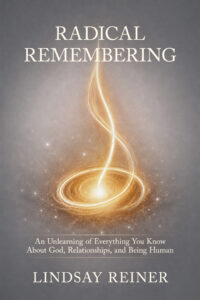 Lindsay Reiner is a writer and visionary exploring what remains when inherited beliefs about God, love, and identity fall away. Her work examines how internal narratives shape human experience and how unlearning can become a path back to truth, agency, and wholeness. Drawing from lived experience, deep inquiry, and spiritual reflection outside religious doctrine, she invites readers to question what they were taught to fear, suppress, or outsource. Radical Remembering is her debut book. https://lindsayreiner.com