
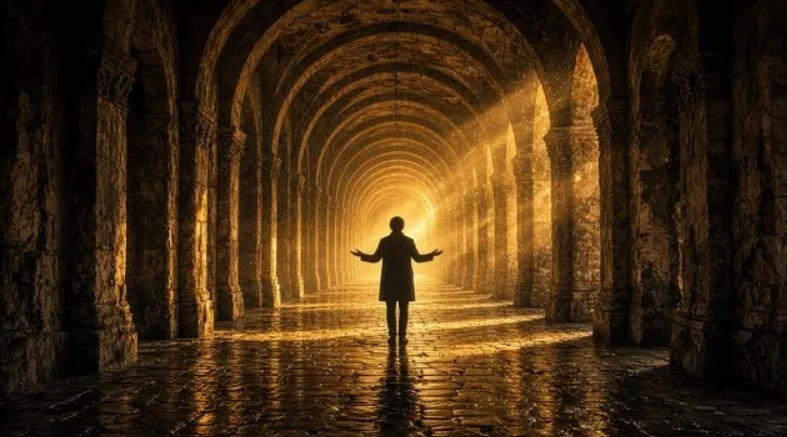
The tunnel with a bright light at the end is one of the most well-known images of near-death experiences. It appears almost like a universal symbol of dying. But how often is this image actually reported?
Not all people who have a near-death experience see a tunnel or a light. Nor do both elements necessarily occur together. Some report only darkness, while others describe a bright light without a preceding tunnel or darkness.
A passage through a tunnel occurs, depending on the study, in approximately 23% to 47% of near-death experiences. The tunnel is usually completely dark or dimly lit. The perception of it seems to vary from person to person.
Many describe it not only as a tunnel, but also as a hole, a vortex, a dark and deep valley with a road-like path, an empty vastness, an airless cylinder, a long passageway resembling a sewer pipe, or an endlessly long path with a golden circle as its entrance. Sometimes there is a twinkling darkness, luminous vapor with fine lines or swirling colors, flashes of color, bricks with a cobblestone path, or a tunnel made of leaves or gray mist. In rare cases (about 10%), the tunnel is brightly lit. Some children describe a square or rectangular tunnel instead of a circular one, or state that they went through spirals.
The movement through the tunnel itself can be upward but also downward. In rare cases, the experiencer returns to their present life through the tunnel. Some people float gently through the tunnel, while others rush through it at great speed. At the end of the tunnel, a light appears, toward which the experiencer moves closer and closer and finally “plunges” into the light. In some cases, the transition from the tunnel into the light can also occur through a kind of gateway, for example through a curtain of pink mist.
An analysis by the University of Liège, Belgium, of the temporal sequence of individual features in near-death experience reports states that in around 69% of cases a bright light is mentioned. This makes it the second most common feature after a feeling of peace. The well-known sequence “out-of-body experience–tunnel–bright light–peace” occurs but can only be identified in about 3.9%. Around 22% contain the features mentioned above, but in a different sequence.
The light is commonly described as radiant, brilliant, bright, and yet warm. It does not resemble any light that we know on Earth. People feel surrounded by it, drawn toward it, or deeply touched by it. It appears white, golden, or accompanied by all the colors of the rainbow. One child even described it as soft pink. Although it is experienced as more intense than any ordinary light, it does not dazzle or cause pain and is often linked to absolute peacefulness or unconditional love. Adelina in our book Where the Light Begins describes the light “as a field of warmth that opened like breath.”
The light is also often associated with a being of light with its own clearly perceptible personality and is sometimes interpreted as God or an angel in those with religious backgrounds. In many cases, there is nonverbal communication with the light that conveys profound philosophical insights.
But why a tunnel with a light at the end of it?
Journalist and researcher Scott Rogo has argued that the tunnel is a kind of symbolic representation of birth — the birth into a new reality.
From a neuroscientific perspective, oxygen deprivation leads to increased gamma activity, particularly in the right hemisphere of the brain, which is responsible for regulating physical stress responses. This reaction could involve the occipital cortex, which is responsible for processing visual information, where excitation of visual neurons could trigger perceptions such as light or tunnel vision.
Neuroscientists at the University of Liège, Belgium, together with colleagues from the University of Copenhagen, Denmark, and the University of Kentucky, USA, expand this theory and state that tunnel and light experiences may result not only from oxygen deprivation, but also from elevated CO₂ levels, which can lead to an energy deficit in the brain. In addition to neuronal excitability in the occipital cortex, there is also an increased release of the body’s own neurotransmitter serotonin (5-hydroxytryptamine), which is particularly concentrated in cortical areas involved in complex information processing and integration, as well as in visual brain areas. Accordingly, hyperactivation of serotonin receptors leads to vivid visual perceptions.
In contrast to this, the classic Western tunnel and light are largely absent in Thai near-death experiences. Instead of a tunnel, the act of walking along roads or paths appears more frequently to symbolize moving between states of consciousness. Instead of a being of light, many people encounter Yama, the Lord of the Dead, in a kind of courtroom setting.
In Japanese reports as well, tunnel experiences are rare. The distinction between this world and another one is made by a river, sometimes together with a field of flowers. As in Western reports, the light is described as extraordinarily bright, non-dazzling, and associated with happiness or euphoria. However, experiencers usually do not interpret it as a personal being and report communication with the light less frequently. The personification of the light could be due to cultural Christian conditioning, as in “God is Light.”
Furthermore, there is a lack of the sense of being loved. The reason might also be the tendency not to express feelings of love verbally in Japanese culture, as well as the lack of the Christian idea that “God is Love.” Japanese experiencers therefore do not interpret overjoyed feelings as given by a divine source. Thus, the basic experience of light may be similar across cultures, while its personal interpretation is shaped by cultural and religious beliefs.
Maybe the tunnel describes less a specific place than a movement: leaving the familiar and approaching something that can hardly be described. At the end of this transition, some people encounter a light. Whether it emerges from the brain or from a reality still unknown to us remains an open question. What is certain is that many people return changed after coming close to it.
Read true stories of children’s near-death experiences and how they responded to them in our book Where the Light Begins: Stories of Near-Death Experiences and After-Death Communications by Children and How They Experience Them Differently Than Adults.
 Ralph and Daniela Klose are German authors and long-term collaborative partners in the fields of neuroscience, psychology, and consciousness research. Their book Where the Light Begins explores near-death experiences in children.
Ralph is a retired neuropsychologist with over three decades of clinical and academic experience, and Daniela is a medical writer and translator specializing in neuropsychology and transpersonal psychology. For many years, they worked as ghostwriters for researchers across Europe. They now write under their own names, connecting scientific expertise with years of hospice and end-of-life care experience to explore near-death-experiences and liminal states of consciousness. https://drklose.com