
Most people think the biggest forces shaping their life are the decisions they make as adults. The career they chose. The partner they picked. The city they moved to. The risks they took or didn’t take. But the real drivers usually formed long before any of those choices existed.
By the time you were about ten years old, your brain had already built a working model of how the world works and who you are inside it. That model didn’t come from careful reflection. It came from observation, emotion, and survival.
Children are meaning-making machines. When something happens, they don’t ask “What’s going on with the adults around me?” They ask a much simpler question:
“What does this mean about me?”
And the answers they come up with tend to stick. Those early conclusions become beliefs. Quiet, invisible rules that sit underneath your adult life, shaping the way you approach love, money, risk, conflict, and even God. The tricky part is that most people never realize they’re following them.
The Invisible Rules You Learned as a Kid
Children don’t learn through lectures. They learn through patterns. If a parent was emotionally distant, a child might conclude: Love requires chasing. If praise only came when they performed well, they might conclude: My worth comes from achievement. If money was a constant source of stress in the household, they might absorb the belief: Money is scarce and hard to keep.
None of these beliefs were consciously chosen. They were assembled quietly, moment by moment, while your brain was trying to make sense of the environment you grew up in. And once those rules formed, your mind began organizing your life around them.
Example #1: Relationships That Feel Strangely Familiar
Have you ever noticed how people often end up dating the same type of person over and over? Different face. Different name. Same emotional dynamic.
Someone who grew up feeling like they had to earn love might find themselves constantly drawn to partners who are distant, inconsistent, or hard to read. Logically, it makes no sense. Who wants a relationship where they’re always trying to prove themselves? But to the nervous system, that dynamic feels familiar. It matches the original blueprint for what love looked like. So the brain interprets the tension as chemistry.
Meanwhile, a calm, emotionally available partner can feel oddly uncomfortable at first. There’s nothing to chase, nothing to decode, nothing to prove. The absence of chaos feels unfamiliar. Many people walk away from healthy connections because their subconscious belief system doesn’t recognize stability as love. It recognizes struggle.
Example #2: The Strange Way We Handle Money
Money is another area where childhood beliefs show up everywhere. Someone who grew up hearing phrases like “money doesn’t grow on trees” or “rich people are greedy” may carry a quiet discomfort with earning or holding onto wealth. Even when opportunities appear, something inside them hesitates.
They might undercharge for their work. Procrastinate on pursuing promotions. Or sabotage financial progress in subtle ways. On the surface, it looks like poor planning or bad luck. Underneath it is often a belief formed decades earlier: Having money makes me bad… or unsafe… or different from the people I love.
The mind protects identity first. If success threatens the identity a person built in childhood, the subconscious will quietly steer them away from it.
Example #3: The Voice in Your Head About Your Worth
Many adults walk through life with a constant internal narrator evaluating everything they do.
You should have done better.
That wasn’t good enough.
People are going to realize you’re not as capable as they think.
That voice didn’t appear randomly. It usually started as someone else’s voice. A critical parent. A teacher who only praised perfection. A household where mistakes were met with anger or embarrassment. Children internalize those reactions quickly. The brain learns: If I stay ahead of the criticism, maybe I can avoid it. So the external voice eventually becomes internal. And decades later, an accomplished adult can still feel like they’re one step away from being exposed as not good enough.
Spiritual Beliefs Start the Same Way
Even our understanding of God often forms this way. If someone grew up hearing about a God who judges, punishes, or withdraws love when you fail, they may carry a subtle fear into their spiritual life. They might pray from a place of anxiety instead of connection. They may feel like they constantly need to prove they are good enough to deserve love or guidance. But those feelings usually come from the human interpretations they were taught as a child, not from direct experience of the Divine. The belief formed early. The emotional pattern followed.
Why These Beliefs Are So Hard to See
Here’s what makes childhood beliefs powerful. They don’t feel like beliefs. They feel like reality. When you’ve carried a mental rule for thirty years, it stops feeling like an assumption and starts feeling like a fact about the world.
“Love always fades.”
“I’m just not someone who’s confident.”
“Money is always stressful.”
“God feels distant.”
These statements sound like observations. But often they’re reflections of a story that started forming in elementary school. Until you question the story, you keep recreating it. Your mind filters the world through it, searching for evidence that confirms what it already decided long ago.
The Good News: Beliefs Can Be Rewritten
None of this means your childhood permanently defined your life. Beliefs are learned patterns. And learned patterns can be changed. But the process starts with awareness. When you begin noticing the emotional themes that repeat in your life, you can trace them back to the beliefs underneath.
The relationship patterns.
The money stress.
The voice in your head that keeps moving the goalposts on your worth.
Most people try to fix the surface behaviors without ever questioning the deeper rule that created them. Real change happens when you find the belief itself and replace it with something truer. Something chosen consciously instead of inherited unconsciously. Because the truth is, the child who formed those beliefs was just trying to make sense of the world. Now you get to decide whether those rules still belong in your life.
If this topic resonates with you, my book Radical Remembering walks you step-by-step through the process of uncovering the beliefs you formed early in life and actively rewriting them. The patterns most people think are permanent often change faster than they ever expected once they see where they came from.
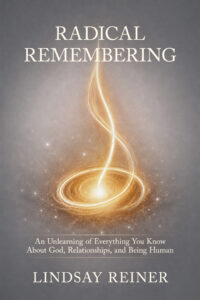 Lindsay Reiner is a writer and visionary exploring what remains when inherited beliefs about God, love, and identity fall away. Her work examines how internal narratives shape human experience and how unlearning can become a path back to truth, agency, and wholeness. Drawing from lived experience, deep inquiry, and spiritual reflection outside religious doctrine, she invites readers to question what they were taught to fear, suppress, or outsource. Radical Remembering is her debut book. https://lindsayreiner.com