
Children are naturally curious. This includes a deep need to talk about death and understand it. From an early age, they try to make sense of life and death. Yet many children learn that conversations about this topic are often considered inappropriate or even uncomfortable in society.
Questions like “When is Grandma coming back?” or “Where did she go?” are therefore often left unanswered or dismissed, and adults often respond with uneasy questions such as: “Why would you ask something like that?”
Particularly preschool children between the ages of about two and five years usually do not perceive death as a final ending. Instead, they tend to see it as a continuation of life under different circumstances and may describe it as “going away” or “falling asleep.” They often understand death as a journey from which someone will eventually return.
Even though children between the ages of five and ten gradually begin to understand that death is both universal and irreversible, they still speak about it with remarkable openness. “Did you see them die?” or “Were they in pain? Did it hurt?”
Interestingly, children who suffer from life-threatening illnesses often demonstrate a more mature and highly developed understanding of death than their healthy peers. They also seem less afraid of death itself than of what they may leave behind. Their worries often center on parents, siblings, and friends. They wonder whether their family will be all right without them. Whether they will be forgotten. Whether their parents will continue living after they are gone. Some children begin consciously leaving traces behind. They write letters, give away treasured objects, take photographs, or choose which toys their family should keep. Beneath these gestures lies something deeply human: a quiet desire to remain present in the hearts of others.
At the same time, many of these children retain an astonishing orientation toward the present. Even when they understand that their time will be limited, they continue to speak about birthdays, friends, dreams, or the professions they hope to have one day. This hope is a kind of inner life force that does not disappear, even in the presence of death. Children often seem to live simultaneously within the awareness of mortality and the love of life itself.
Many terminally ill children develop a striking philosophical depth. They speak of places without pain, or describe death through images of light, peace, warmth, or reunion. What is remarkable is that children often allow spiritual understandings and biological aspects of death to coexist without conflict. They may understand that the body stops functioning, while they still sense that something of the person continues, “like a light that breathes” as Dalia describes it in our book Where the Light Begins.
As children grow older, their relationship to death changes. Younger children often meet death more calmly because they do not yet fully grasp its finality. Older children and adolescents begin to ask existential questions: “What happens after death?” “Why do people die?” “Will we be remembered?” “What remains of a person?”
Again and again, children appear more open toward death than adults expect. They want to ask questions. To understand. To find meaning. Studies suggest that children raised in cultures where death is spoken about more openly often develop a quieter and less fear-driven relationship to mortality. In these cultures, death remains connected to ritual, memory, family, and conversation. Maybe this reveals something adults have forgotten: that fear of death does not arise only from death itself, but also from the silence surrounding it.
Across many hospice experiences, one impression appears with striking consistency: children are not passive in the face of dying. They develop active, relational, and often deeply reflective ways of meeting it. They seek connection. Meaning. Honesty. Closeness. And perhaps, through this, they reveal something essential about being human.
Because even where life becomes visibly shorter, children continue to search for joy, play, tenderness, and presence. They remind us that living and dying are not entirely separate rooms. Between them there seems to exist a quiet threshold and children sometimes appear able to sense it with a clarity many adults have long lost.
Read true stories of children’s near-death experiences and how they responded to them in our book Where the Light Begins: Stories of Near-Death Experiences and After-Death Communications by Children and How They Experience Them Differently Than Adults.
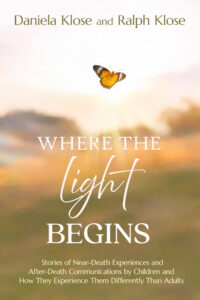 Ralph and Daniela Klose are German authors and long-term collaborative partners in the fields of neuroscience, psychology, and consciousness research. Their book Where the Light Begins explores near-death experiences in children.
Ralph is a retired neuropsychologist with over three decades of clinical and academic experience, and Daniela is a medical writer and translator specializing in neuropsychology and transpersonal psychology. For many years, they worked as ghostwriters for researchers across Europe. They now write under their own names, connecting scientific expertise with years of hospice and end-of-life care experience to explore near-death-experiences and liminal states of consciousness. https://drklose.com